

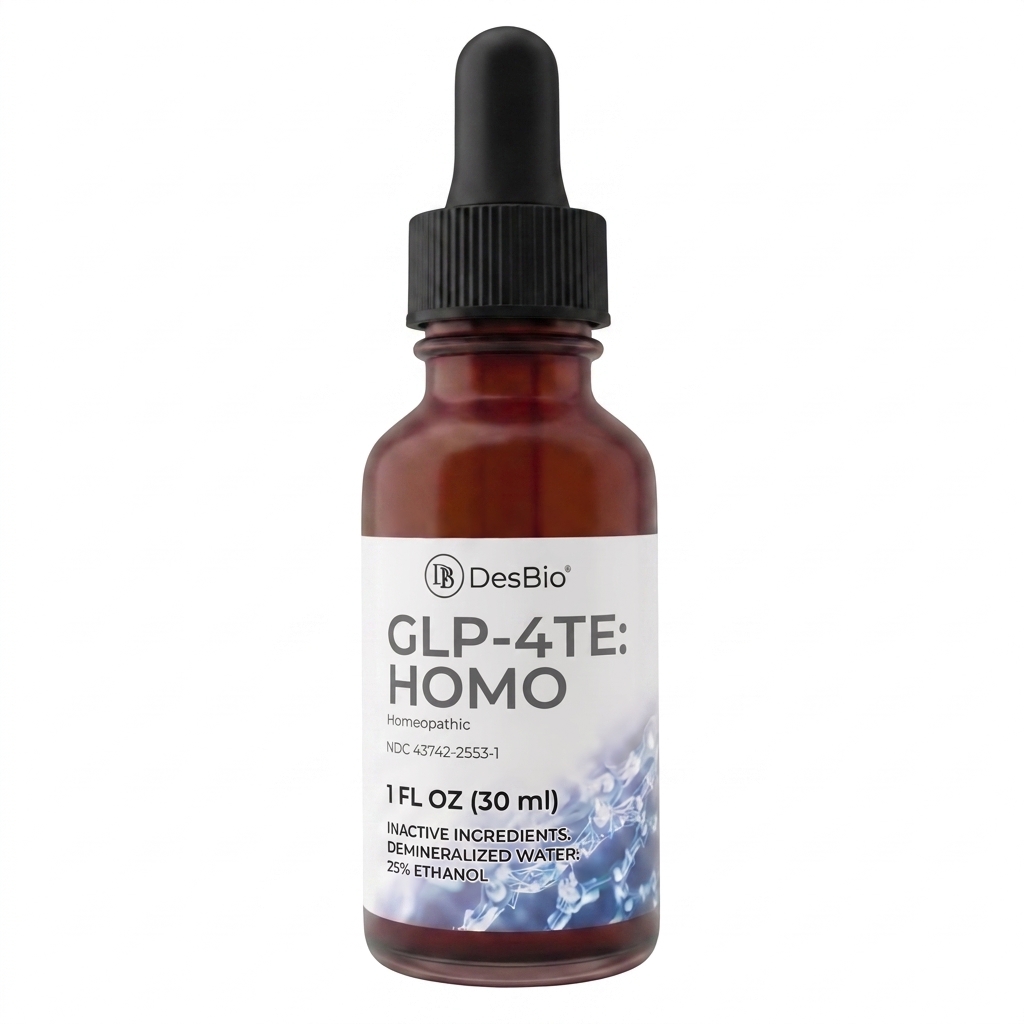




How It Works With Your Protocol
The GLP-4TE Homochord is designed specifically to complement the GLP-4TE CSSR Weight System by providing daily homeopathic support between scheduled CSSR vials.
The GLP-4TE CSSR Phase 1 and Phase 2 kits remain the foundation of the protocol. Their sequential vials progress through increasingly deeper homeopathic potencies that may provide structured metabolic repatterning over time.
The Homochord serves a different, intentionally supportive role. Used on the days between CSSR vials, it helps maintain consistent homeopathic support for appetite regulation, satiety, healthy glucose metabolism, energy, and metabolic signaling throughout the active protocol.

Daily Support for the Metabolic Signals That Influence Weight
The GLP-4TE Homochord combines homeopathic ingredients selected to support many of the physiological systems involved in healthy weight regulation, including:
- Healthy appetite regulation
- Satiety signaling and stomach fullness
- Healthy glucose metabolism
- Insulin function
- Liver metabolic support
- Healthy fat metabolism
- Energy production
- Healthy inflammatory balance
- Leptin sensitivity
- GLP signaling pathways
The Homochord provides consistent daily support that practitioners can easily integrate throughout a patient's weight-management journey.
One Integrated Protocol. Two Distinct Roles.
The GLP-4TE CSSR Weight System and GLP-4TE Homochord are designed to work together, but they are not interchangeable.

GLP-4TE CSSR Phase 1 and Phase 2
The CSSR kits provide the primary sequential protocol. Each vial advances through progressively deeper homeopathic potencies, creating a structured approach that may support metabolic signaling and regulation over time.

GLP-4TE Homochord
The Homochord provides consistent daily companion support on the days between scheduled CSSR vials. It combines multiple potencies in one formula to help reinforce the core metabolic support of the GLP-4TE system throughout the active protocol.
The Homochord does not replace the CSSR sequence. It helps support continuity between the deeper, progressively sequenced vials.
Supports Multiple Metabolic Pathways
Healthy weight regulation depends on coordinated communication among several physiological systems, not a single hormone or organ.[1-4]

Appetite & Satiety
Supports healthy appetite regulation while promoting signals associated with stomach fullness and healthy eating behaviors. GLP-1 and other gastrointestinal peptides participate in the physiological regulation of appetite, food intake, satiety, and gastric emptying.[1-3]

Glucose & Insulin Balance
Supports healthy glucose utilization, insulin function, and metabolic flexibility. Insulin and GLP-1 contribute to the regulation of post-meal glucose, insulin secretion, glucose disposal, and hepatic glucose production.[3-5]

Healthy Energy Production
Supports efficient metabolic energy production to help patients maintain vitality during weight-management programs.

Liver & Metabolic Function
Provides homeopathic support for healthy liver function, an essential component of normal metabolic regulation. The liver plays a central role in glucose homeostasis, insulin clearance, glycogen metabolism, gluconeogenesis, and lipid metabolism.[5-7]

Healthy Metabolic Signaling
Supports multiple communication pathways involved in appetite regulation, satiety, and healthy metabolic balance. These pathways include communication among the gastrointestinal tract, pancreas, liver, adipose tissue, hypothalamus, and broader central nervous system.[1-4,8-9]
What Is a Homochord?
Consistent Support Between the Deeper CSSR Vials
A Homochord is a homeopathic formulation that combines multiple potencies of the same ingredients within one remedy. In the GLP-4TE Weight System, this format is used to provide consistent homeopathic support on the days between scheduled CSSR vials.
The CSSR protocol progresses sequentially through increasingly deeper potencies. Each vial is used according to the structured Phase 1 and Phase 2 schedule to support deeper metabolic repatterning over time.
The GLP-4TE Homochord does not follow that same progressive sequence. Instead, it brings multiple potencies together in one daily companion formula, helping maintain continuity and reinforce the system's foundational metabolic support between vials.
Think of the CSSR vials as the deeper steps of the protocol and the Homochord as the support that connects those steps.
Why Use the Homochord Between Vials?
The GLP-4TE Homochord is designed to:
- Provide daily homeopathic support between scheduled CSSR vials
- Reinforce the foundational metabolic focus of the GLP-4TE system
- Support appetite, satiety, glucose metabolism, and energy throughout the active protocol
- Create continuity as patients progress through Phase 1 and Phase 2
- Complement, not replace, the deeper CSSR vial sequence
The Homochord supports the rhythm of the protocol. The CSSR vials drive its progression.


Explore the Full GLP-4TE Weight and Metabolic System
See the complete GLP-4TE CSSR Weight System, including Phase 1 and Phase 2 protocol details and how the full program supports healthy metabolic regulation.
View Full Program DetailsHow It Fits Into the GLP-4TE Weight System
GLP-4TE Homochord is intended for use as daily companion support throughout the active GLP-4TE CSSR protocol.

On Scheduled CSSR Vial Days
Use the appropriate Phase 1 or Phase 2 CSSR vial according to the practitioner-directed protocol.
Between Scheduled CSSR Vials
Use GLP-4TE Homochord as directed to provide ongoing daily homeopathic support until the next CSSR vial is administered.
Continue Through Both Phases
The Homochord may be used between vials throughout both GLP-4TE CSSR Phase 1 and Phase 2, unless otherwise directed by the practitioner.
Always follow the official GLP-4TE protocol and product dosing instructions.
These statements have not been evaluated by the Food and Drug Administration. This product is not intended to diagnose, treat, cure, or prevent any disease. Claims regarding the Homochord and its ingredients are based upon traditional homeopathic practice and the intended formulation rationale, not clinical trials demonstrating that GLP-4TE Homochord produces the physiological effects described in the cited metabolic research.
References
- Shah M, Vella A. Effects of GLP-1 on appetite and weight. Reviews in Endocrine and Metabolic Disorders. 2014;15(3):181-187. doi:10.1007/s11154-014-9289-5.
- Beglinger C, Degen L. Gastrointestinal satiety signals in humans: physiologic roles for GLP-1 and PYY? Physiology & Behavior. 2006;89(4):460-464. doi:10.1016/j.physbeh.2006.05.048.
- Müller TD, Finan B, Bloom SR, et al. Glucagon-like peptide 1 (GLP-1). Molecular Metabolism. 2019;30:72-130. doi:10.1016/j.molmet.2019.09.010.
- Drucker DJ. Mechanisms of action and therapeutic application of glucagon-like peptide-1. Cell Metabolism. 2018;27(4):740-756. doi:10.1016/j.cmet.2018.03.001.
- Dimitriadis GD, Maratou E, Kountouri A, Board M, Lambadiari V. Regulation of postabsorptive and postprandial glucose metabolism by insulin-dependent and insulin-independent mechanisms: an integrative approach. Nutrients. 2021;13(1):159. doi:10.3390/nu13010159.
- Petersen MC, Vatner DF, Shulman GI. Regulation of hepatic glucose metabolism in health and disease. Nature Reviews Endocrinology. 2017;13(10):572-587. doi:10.1038/nrendo.2017.80.
- Guerra S, Gastaldelli A. The role of the liver in the modulation of glucose and insulin in nonalcoholic fatty liver disease and type 2 diabetes. Current Opinion in Pharmacology. 2020;55:165-174. doi:10.1016/j.coph.2020.10.016.
- Klok MD, Jakobsdottir S, Drent ML. The role of leptin and ghrelin in the regulation of food intake and body weight in humans: a review. Obesity Reviews. 2007;8(1):21-34. doi:10.1111/j.1467-789X.2006.00270.x.
- Myers MG Jr, Leibel RL, Seeley RJ, Schwartz MW. Obesity and leptin resistance: distinguishing cause from effect. Trends in Endocrinology & Metabolism. 2010;21(11):643-651. doi:10.1016/j.tem.2010.08.002.